SafeRide
Download
What We Do
How It WorksFor SurvivorsPrivacy & TrustRoute Safety IndexImpact
Open Source
Our Story
Partners
Blog
Download App
What We Do
How It WorksFor SurvivorsPrivacy & TrustRoute Safety IndexImpact
Open Source
Our Story
Partners
Blog
Download App

Route Safety Index

Route accountability starts with redacted, consented signals.

SafeRide's route-safety concept is grounded in the app pathway called Anonymous map update: share redacted where/when and incident type, with no names and no audio.

Private evidence. Public safety signals.

The Route Safety Index should only use data that is minimized, aggregated, privacy-reviewed, and useful to operators, civic partners, regulators, and support organizations.

No

names or raw audio in anonymous map updates

Coarse

location and timing before aggregation

Pilot

evidence needed before public scoring
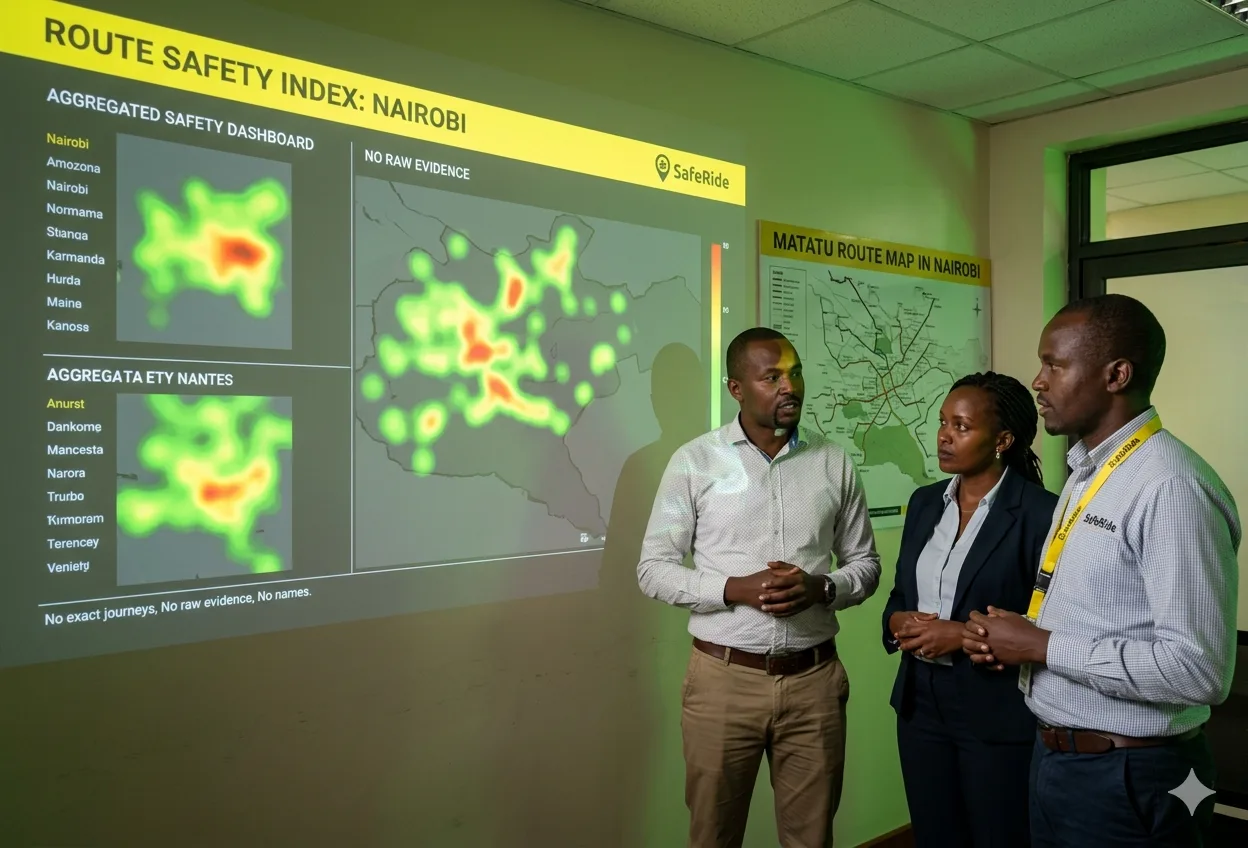
Anonymized route safety dashboard and Nairobi route map reviewed by transport stakeholders

Repo-backed detail

Evidence reviewers can inspect.

Anonymous map update

Only redacted route facts belong in public signals.

The pathway is written around where/when and incident type, while excluding names, raw audio, and survivor-identifying details.

Aggregation

Small samples should not become public scores.

Route scoring needs thresholds, time windows, bias notes, and methodology limits before it can responsibly inform operators or regulators.

Action loop

A route index is only useful if partners respond.

The pilot should test whether transport partners can convert aggregate signals into lighting, staffing, reporting, and follow-up changes.

Anonymous map update

The pathway copy explicitly limits map contribution to redacted where/when and type, with no names or audio.

Escalation packet

When a rider chooses action, the escalation form supports redaction levels, vehicle plate, SACCO/operator, alias contact, and packet preview.

Case follow-up

Submitted cases can move through status, timeline events, attachment previews, deletion requests, and offline retry states.

Index guardrails before launch

  1. 01Define minimum sample thresholds so small groups or exact journeys are not exposed.
  2. 02Separate anonymous route signals from private drafts, evidence files, and referral briefs.
  3. 03Publish methodology, limitations, and known bias before displaying public scores.
  4. 04Give operators and civic partners action loops without giving them survivor-identifying data.

Ready to help make the next route safer?

Join as a pilot partner
SafeRide

Safer journeys. Open by design.

Product

  • What We Do
  • How It Works
  • For Survivors
  • Route Safety Index
  • Privacy & Trust

Open Source

  • Open Source Overview
  • GitHub
  • HuggingFace Model
  • License Posture
  • Security Roadmap

Partners

  • Pilot Partners
  • Support Organizations
  • Transport Operators
  • Engineering Reviewers
  • Partner with Us

Organisation

  • Our Story
  • Impact
  • About Esheria
  • Privacy Guide
  • Contact

© 2026 Esheria Ventures Limited

Apache 2.0 CC-BY 4.0 Built in Nairobi, Kenya 🇰🇪